Journal · Punta Cana
Best Time to Visit Punta Cana: Weather, Rain and Sargassum
Choose your travel dates around the holiday you want. Compare verified monthly climate averages, understand hurricane-season dates and plan realistically for rain, sea conditions and sargassum.

The best time depends on what you want from your holiday
If lower historical rainfall is your main priority, February to April is a useful starting shortlist: these are the three lowest monthly rainfall totals in the Punta Cana station’s 1991–2020 normals shown below. That is a comparison of a historical baseline, not a forecast for your dates or a promise of rain-free beaches. There is no single month that guarantees ideal conditions for every activity.
Start with your priorities: time on the sand, an island outing, learning a water sport or a flexible week with different experiences. Do not assume that a rainfall ranking also ranks wind, snorkeling visibility, seaweed, prices or crowds. Those require different information. Once your dates are fixed, our seven-day Punta Cana itinerary helps you leave room to adjust individual outings.
Punta Cana by month: use climate averages as a baseline
The table uses the WMO climate normals for 1991–2020 published in NOAA NCEI’s Punta Cana station file, WMO 78479, checked on 28 October 2026. It shows average daily minimum air temperature and average monthly precipitation total. Minimum temperature is not the daytime high, sea temperature or a nightly forecast. The figures describe that station and period, not every beach or resort.
February, March and April have lower rainfall totals in this series than May or September. The pattern is not a steadily increasing or decreasing wet season: July also has a lower total than several surrounding months. A monthly total does not say when rain falls, how long a shower lasts or how many holiday days will be affected. These historical normals are not a prediction of current climate or a particular future year.
| Month | Average daily minimum air temperature (°C) | Average monthly rainfall (mm) |
|---|---|---|
| January | 21.2 | 84.7 |
| February | 21.2 | 62.8 |
| March | 21.7 | 50.4 |
| April | 22.5 | 64.9 |
| May | 23.5 | 129.3 |
| June | 24.2 | 93.7 |
| July | 24.2 | 84.7 |
| August | 24.3 | 106.7 |
| September | 24.1 | 135.3 |
| October | 23.8 | 123.6 |
| November | 22.9 | 131.1 |
| December | 21.9 | 91.3 |
Rainy season does not describe an entire holiday day
A label such as rainy season compresses different weather patterns into a few words. Use the monthly rainfall comparison to understand the historical pattern, then use a current local forecast for the dates that matter. Neither a monthly average nor a daily rain icon tells you that rain will last all day. Equally, do not assume that every shower is brief or arrives at a convenient time.
Before a planned outing, check the forecast’s location, issue time and time period. Recheck closer to departure and ask the operator about the activity, route and meeting point. If plans change, agree what happens next rather than substituting another outdoor activity automatically. A restaurant visit or hotel time only works as an alternative when current conditions and arrangements allow it.
Hurricane season: calendar dates are not a local forecast
The official Atlantic hurricane season runs from 1 June to 30 November. NOAA’s National Hurricane Center also notes that tropical cyclones can occur outside that window. These dates describe the Atlantic basin’s season; they do not mean that Punta Cana is under a warning every day in those months, or that a date outside the window carries no weather risk.
Before travel and during your stay, check current guidance from the Dominican meteorological service, INDOMET, and follow local authorities and your accommodation’s instructions. This article is not a live alert feed. Confirm how your transport and excursion providers communicate changes, and read the terms of any travel cover you choose. A seasonal label alone does not establish that a departure will operate or be cancelled.
Sargassum: regional outlooks cannot promise your beach conditions
Sargassum is floating brown seaweed that can reach the shoreline. NOAA’s monitoring work distinguishes offshore presence from coastal inundation: currents, tides, wind and waves influence whether it reaches a particular shore. A regional satellite outlook is useful context, but it is not a reliable promise of the appearance of one hotel beach months ahead.
Do not buy a date or accommodation on a guarantee of an algae-free month. Ask for a recent, dated update for the actual beach you plan to use, and understand that conditions can change after that update. Our Punta Cana beach comparison helps you distinguish the coastal locations and visitor access; it does not rank them by guaranteed seaweed conditions.
Sunshine, sea state and underwater visibility are different conditions
A sunny sky is not confirmation that a boat route, swim or snorkeling stop is suitable. For an island day, ask about the complete route and current operating decision, including road transfer and boat boarding. Read the Saona visitor guide and Catalina visitor guide to understand their different outings before choosing a date or option.
For water activities, follow the operator’s assessment and current local restrictions. Do not infer snorkeling visibility from a rainfall average, or expect another island to provide guaranteed clear water or seaweed-free sand. Your decision should be based on the named itinerary and actual conditions, not a perfect promotional photograph.
 Islands & nature
Punta Cana · Dominican Republic
Saona Island Tour
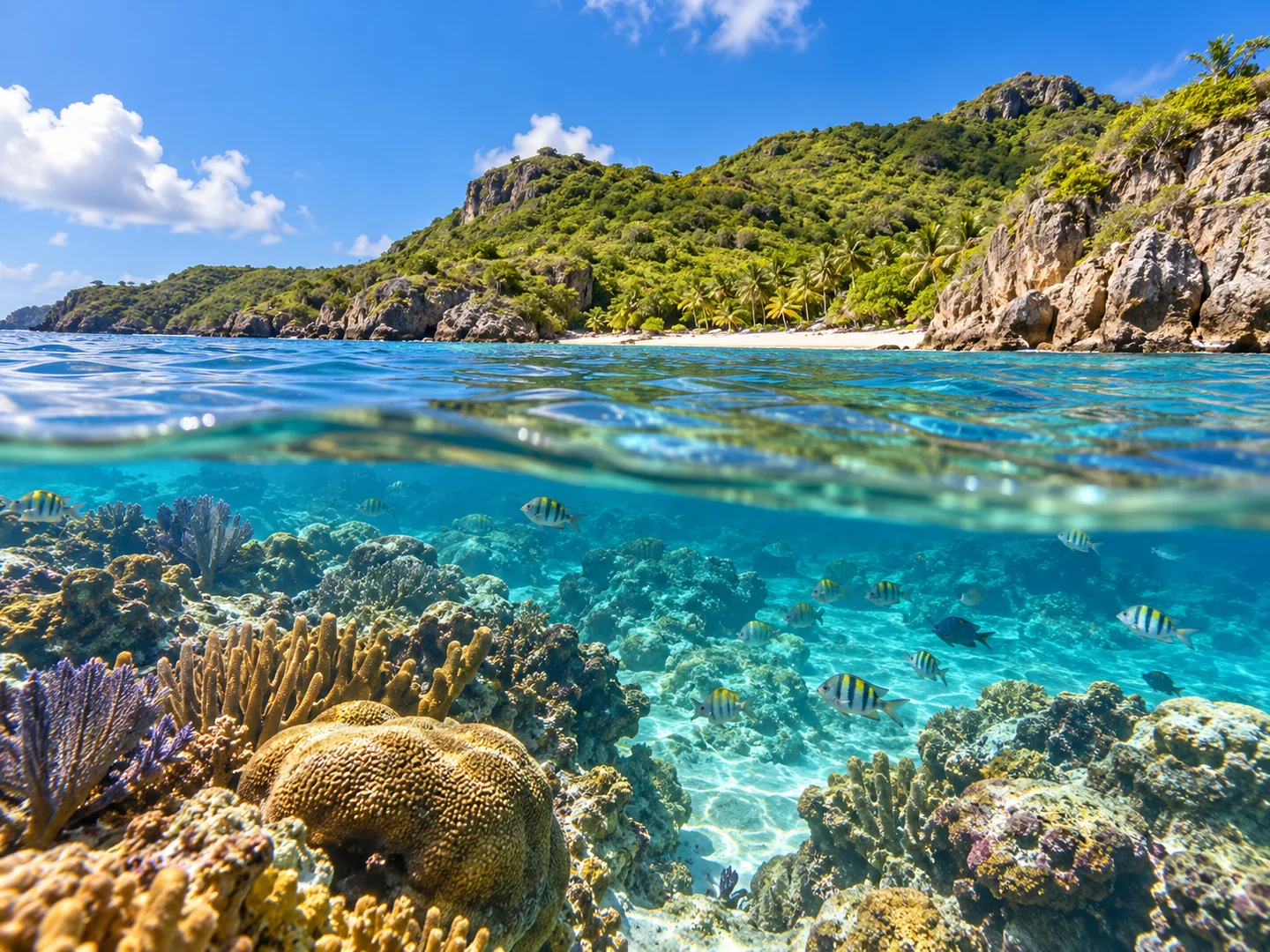
Palm-fringed beaches, Caribbean blues and an island day beyond the resort. Compare the boat route and beach time before choosing your Saona excursion.
 Islands & nature
Punta Cana · Dominican Republic
Catalina Island Tour
A Caribbean island escape with a snorkeling focus. Plan the reef stop, boat journey and beach break as distinct parts of your Catalina day.
Wind sports and land outings need their own assessment
Kitesurfing needs appropriate wind and a school’s assessment of the learner and location. The lowest-rainfall month is not automatically the right teaching day. Use the Punta Cana kiteboarding guide to understand the lesson format; if instruction is your goal, compare kitesurf courses and confirm how unsuitable conditions affect your booking.
Rain can also change the conditions of a walking route or a driving track. The Ojos Indígenas visitor guide and buggy and cenote guide explain distinct outings. Neither should be presented as an all-weather replacement for a boat trip. Ask about the actual route, current access and whether the proposed activity meets your group’s needs.

Keep flexibility in your itinerary and clarity in your booking
When possible, avoid placing your only condition-dependent outing immediately before departure. A spare day can create room to discuss rescheduling, although it does not guarantee availability or better conditions. If you must travel on fixed dates, choose around your priorities and keep the daily order flexible rather than treating a monthly climate table as a timetable.
Before paying, ask who decides whether the activity runs, when you will be told and how postponement, a changed itinerary, an alternative activity or a refund is handled. Confirm whether transfers and separate admission arrangements are affected too. No universal cancellation rule is established by this guide; keep the terms for your particular booking in writing.
Common questions about when to visit Punta Cana
Is the driest month guaranteed to be the best? No: the historical rainfall total answers only one part of the choice. Does a rain symbol mean a whole day indoors? It does not establish duration or conditions at your exact location; check the forecast detail. Can a month outside hurricane season be treated as weather-proof? No. Can a sargassum-free beach be guaranteed months ahead? This guide makes no such promise.
Should you cancel an activity yourself because of a forecast icon? Contact the provider about the current decision and your booking terms; do not assume a refund or ignore official instructions. Is an inland outing always a suitable backup? No: access and route conditions need their own assessment. Are the climate figures a current forecast? No: they are explicitly the 1991–2020 historical baseline for one station.
Choose your dates, then plan the details that remain
Use the historical comparison to narrow your travel window if you have that flexibility. Then check your actual flights, accommodation and the experiences that matter most. Current prices, availability, access and weather remain separate questions; this article does not declare any month cheapest, quietest or universally suitable for swimming.
If you already have your dates, you can still improve the plan. Share your accommodation, group and priorities through our planning contact page. Ask for an itinerary with realistic room for changes and written service terms, then use current information before each outing. The aim is a well-prepared holiday rather than a promise of perfect weather.
Plan your next step
Plan around your dates and priorities
Tell us when you are travelling, where you are staying and which experiences matter most. We can help you plan the order and identify the conditions and booking terms to confirm.
Ask a planning question